cook
cook

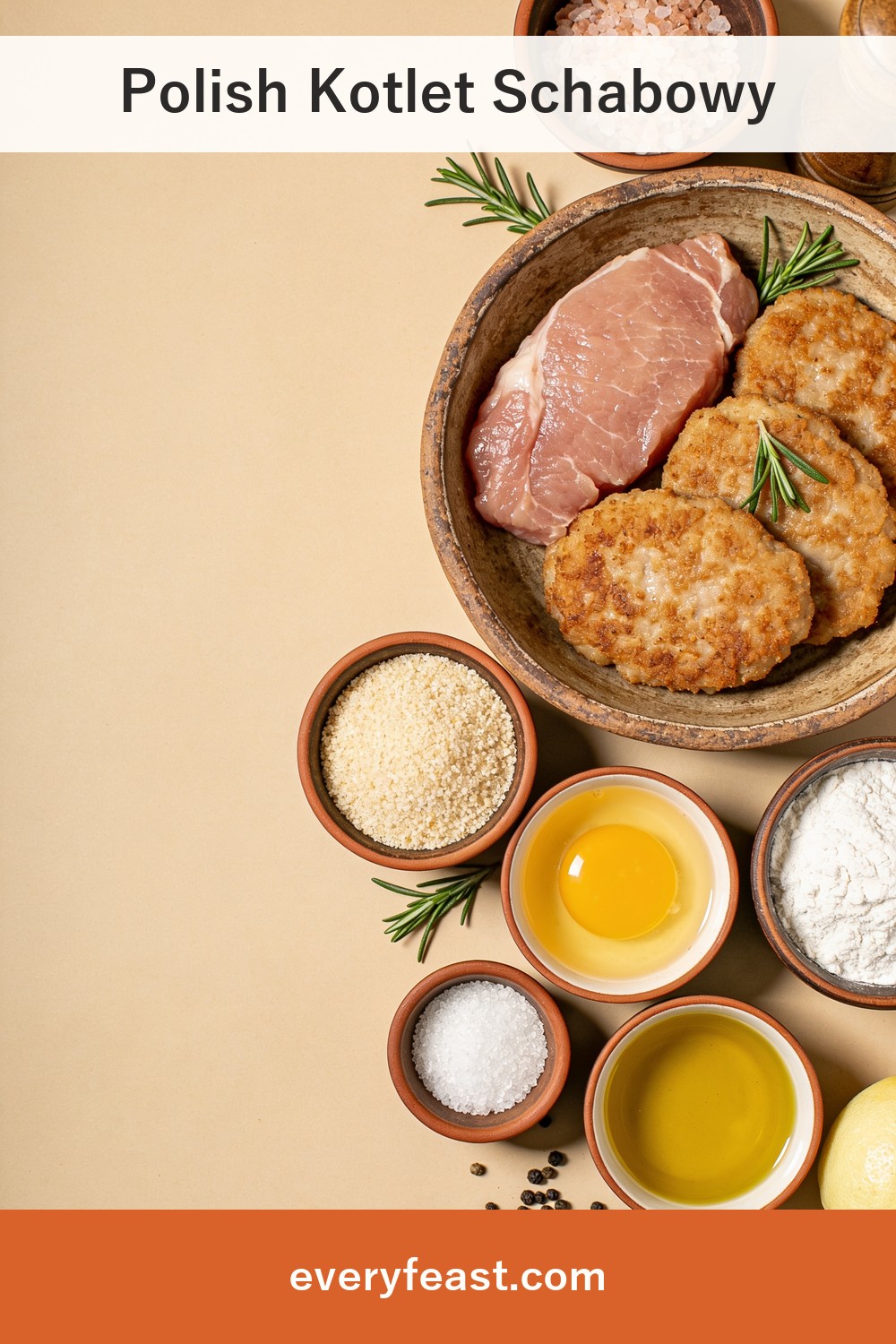
Kotlet schabowy are Poland’s beloved breaded pork cutlets—thin, tender slices of pork loin pounded until delicate, then coated in crispy breadcrumbs and pan-fried until golden and crunchy. Traditionally served with a squeeze of fresh lemon and a side of potatoes or cucumber salad, they’re simple, elegant, and ready in under 30 minutes.
What is kotlet schabowy?
Kotlet schabowy is a classic Polish dish and a staple of home cooking across Eastern Europe. It’s built on a straightforward technique: a boneless pork chop (or loin cutlet) is gently pounded thin, dredged through flour, beaten egg, and fine breadcrumbs, then pan-fried in oil or butter until the coating turns golden and crispy. The inside stays tender and juicy. It’s often served with a spritz of lemon juice and sides like boiled potatoes, creamed mushrooms, or tangy cucumber salad.
Why you’ll love it
- Ready in under 30 minutes—perfect for weeknight dinners
- Simple three-step breading technique yields a crunchy, restaurant-quality crust
- Incredibly versatile: serve with potatoes, rice, or salad, and dress it up or down as you like
Ingredients (serves 4)
| Ingredient | Amount | Where to find it / Substitutes |
|---|---|---|
| Boneless pork loin chops (or thin cutlets) | 4 pieces, 150–175 g each | Meat counter; ask butcher to pound thin or do it yourself |
| All-purpose flour | 50 g (0.4 cup) | Baking aisle |
| Eggs | 2 large | Dairy aisle |
| Fine breadcrumbs (panko or Japanese-style) | 100 g (1 cup) | Baking aisle; or make your own from crushed crackers |
| Salt and black pepper | To taste | Pantry staples |
| Vegetable oil or clarified butter | 100 ml (0.4 cup) | Cooking oil section; or use olive oil |
| Fresh lemon | 1 large | Produce section |
| Fresh parsley (optional garnish) | 2 tbsp, chopped | Produce section or fresh herbs |
Allergens: Wheat (flour, breadcrumbs); eggs; pork must be fully cooked through with no pink remaining in the center.
How to make it
-
Prepare the pork: Pat the pork chops dry with paper towels. Working one at a time, place a chop between two sheets of plastic wrap or parchment paper. Using the flat side of a meat mallet or the bottom of a heavy skillet, gently pound the chop until it is about 0.5 cm (0.2 inches) thick and roughly doubled in size. Try to create an even thickness so it cooks uniformly. Set aside on a clean plate and repeat with the remaining chops.
-
Set up your breading station: Place three shallow bowls in a row. In the first, mix the flour with a pinch of salt and black pepper. In the second, beat the two eggs together with a pinch of salt. In the third, spread out the breadcrumbs on a flat plate.
-
Bread the cutlets: Take one pounded chop and coat both sides lightly with the flour mixture, shaking off any excess. Dip it into the beaten egg, allowing any excess to drip off, then place it on the breadcrumb plate. Press gently and flip to coat both sides thoroughly with breadcrumbs, pressing lightly so they adhere. Set on a clean plate and repeat with the remaining cutlets. Let them rest for 10 minutes so the coating adheres better.
-
Pan-fry: Heat the oil or butter in a large skillet over medium-high heat until shimmering (about 1–2 minutes). Carefully lay the breaded cutlets into the hot oil, being mindful of splattering. Fry for 4–5 minutes on the first side until golden brown and crispy. Flip carefully and fry for another 4–5 minutes until the second side is golden brown and the pork is fully cooked through with no pink remaining in the center. If the coating browns too quickly, reduce the heat to medium.
-
Finish and serve: Transfer the cooked kotlets to a paper towel-lined plate to drain any excess oil. Arrange on a serving plate and garnish with fresh lemon wedges and chopped parsley if desired. Serve immediately while hot and crispy, with lemon juice squeezed over top.
Tips for success
- Pound evenly: The thinner and more uniform the cutlets, the faster and more evenly they cook. Don’t be afraid to pound them thin.
- Don’t skip the resting step: Letting the breaded cutlets sit for 10 minutes helps the coating stick better during frying.
- Use a meat thermometer: For guaranteed doneness, the pork should reach an internal temperature of 63℃ (145℉). Check at the thickest part without touching bone.
- Keep the oil hot: Cold oil will absorb into the coating instead of crisping it. Test with a tiny piece of bread—it should sizzle immediately.
- Don’t crowd the pan: Fry in a single layer. If needed, work in batches so the oil temperature doesn’t drop and the coating stays crispy.
Variations / Storage
- Chicken version: Use thin chicken breasts or pounded chicken thighs instead of pork. Reduce frying time slightly to 3–4 minutes per side (chicken cooks faster).
- Herb breadcrumbs: Mix dried herbs (oregano, thyme, parsley) or grated cheese into the breadcrumbs for extra flavor.
- Panko coating: Use panko breadcrumbs for an even crunchier texture.
- Cream sauce: Serve alongside a simple sauce of sour cream mixed with Dijon mustard and fresh dill.
- Storage: Cooked kotlets can be stored in an airtight container in the refrigerator—storage life varies with conditions. Reheat gently in a 160℃ (320℉) oven for 8–10 minutes to restore crispness. Uncooked breaded cutlets can be frozen; fry directly from frozen, adding 1–2 minutes to each side.
FAQ
Q. Can I bake these instead of pan-frying?
A. Yes—place them on an oiled baking sheet and bake at 190℃ (375℉) for 15–18 minutes, flipping halfway through. The crust won’t be quite as crispy as pan-fried, but it’s a lighter option.
Q. What if my coating falls off during frying?
A. Make sure your cutlets are completely dry before breading, and don’t skip the 10-minute resting step. The egg acts as glue; don’t skip it.
Q. How thick should I pound the pork?
A. Aim for about 0.5 cm (0.2 inches)—thick enough to stay tender and juicy, thin enough to cook quickly and evenly.
Q. Can I make these ahead and fry them later?
A. Yes—bread them and refrigerate uncovered on a tray for up to 4 hours. Fry from cold; they’ll cook through perfectly.
Q. What’s the best side dish to serve with kotlet schabowy?
A. Boiled or mashed potatoes, steamed vegetables, rice, or a crisp salad with vinaigrette all pair beautifully. A traditional Polish pairing is creamed mushrooms and boiled potatoes.