Japanese Seasoning Substitutes: What to Use When You Can’t Find Mirin, Dashi or Sake
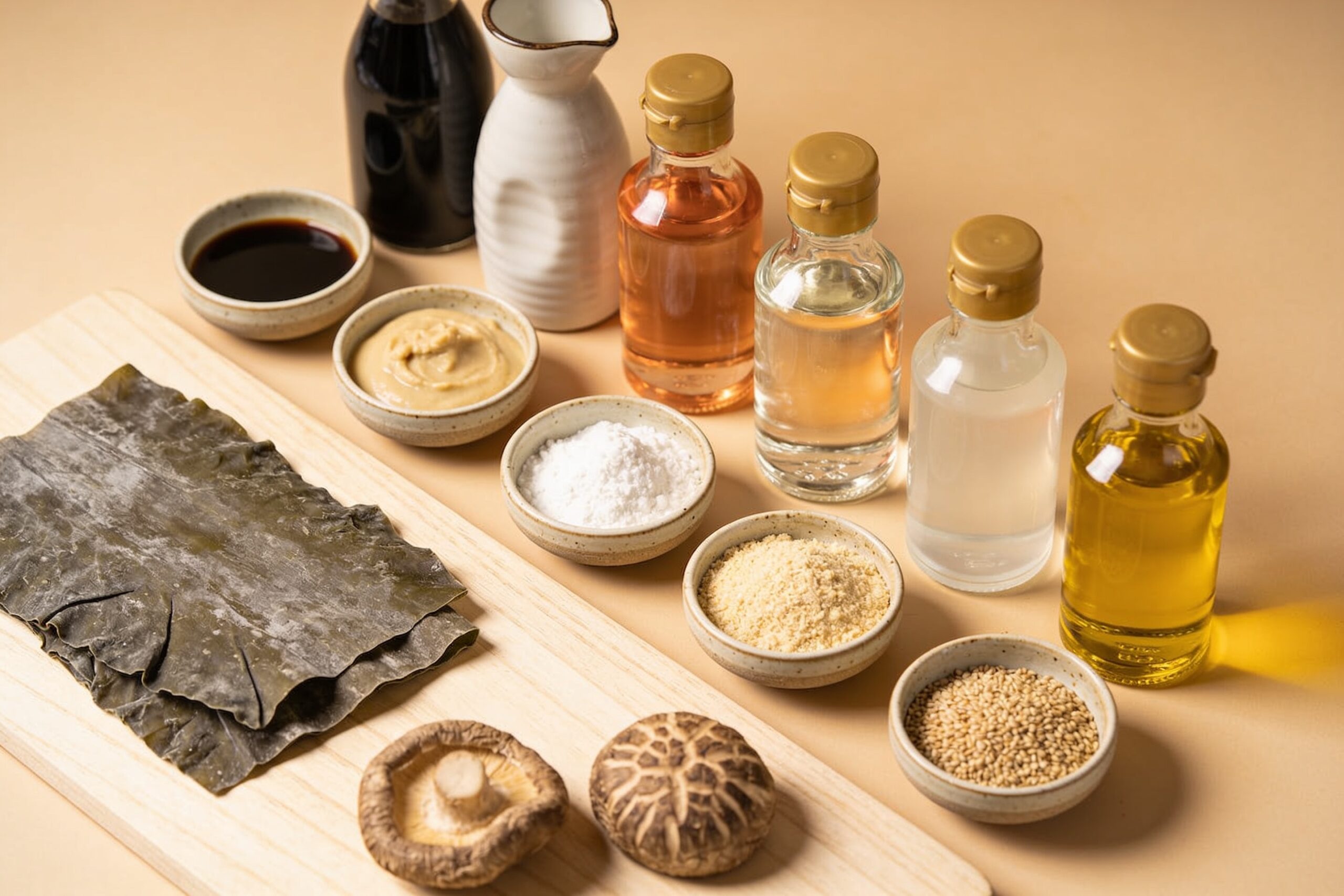
Most Japanese recipes fail outside Japan for one reason: a bottle you cannot buy.
This page exists to stop that. For each Japanese pantry staple, it tells you what the ingredient actually does in the dish, what to use instead, and — the part most guides skip — how the result will differ.
Read this first: substitute the job, not the name
A single Japanese seasoning usually does more than one job at once. Mirin, for example, does three:
- Sweetness — a mild, rounded sugar
- Gloss — the shine on teriyaki and simmered dishes (teri, 照り)
- Odour control — its alcohol strips the smell from fish and meat
No substitute covers all three. Sugar alone gives you sweetness and nothing else. Once you know which job matters in your dish, choosing a substitute becomes obvious — and you stop expecting a swap to be invisible.
Every entry below is written that way: job first, swap second.
Quick reference
| You can’t find | Use this | Ratio | What changes |
|---|---|---|---|
| Mirin | Sake + sugar | 1 tbsp sake + 1 tsp sugar = 1 tbsp mirin | Very close. Slightly less gloss |
| Mirin (no alcohol) | Water + sugar | 1 tbsp water + 1 tsp sugar | Sweetness only. No gloss, no odour control |
| Cooking sake | Dry sherry | 1:1 | Close. Slightly nuttier |
| Cooking sake (no alcohol) | Water | 1:1 | Loses tenderising and odour control |
| Dashi | Kombu + dried shiitake | 10 g kombu + 2 shiitake per 1 litre | Earthier, less oceanic. Vegan |
| Dashi | Instant dashi powder | Per packet | Very close. Usually contains fish |
| Soy sauce (Japanese) | Any all-purpose soy sauce | 1:1 | Fine. Chinese light soy is saltier — start with less |
| Soy sauce (gluten-free) | Tamari | 1:1 | Slightly rounder. Check the label |
| White miso | Red miso, reduced | Use ⅔ the amount | Much saltier and stronger |
| Rice vinegar | Cider vinegar + water | 3 parts vinegar : 1 part water | Fruitier, sharper |
| Potato starch | Cornstarch | 1:1 | Crust is less shattery, browns faster |
| Panko | Coarse dried breadcrumbs | 1:1 | Denser, less crisp |
| Japanese mayo | Mayo + rice vinegar + pinch sugar | 1 cup + 1 tsp + pinch | Close. Real thing is yolk-only and tangier |
Details, and the mistakes to avoid, are below.
Mirin (みりん)
Its job: sweetness, gloss, odour control.
Before you substitute, check which bottle you actually have. This trips up more cooks than anything else on this page.
| Label says | What it is | Alcohol |
|---|---|---|
| Hon-mirin (本みりん) | The real thing. Brewed, no added sugar | 10–14% |
| Aji-mirin (味みりん) / mirin-fu chomiryo (みりん風調味料) | A seasoning made to taste like mirin. Water, corn syrup, rice, salt | Under 1% |
Most bottles sold in Western supermarkets are aji-mirin. It is not naturally fermented, so it carries little umami, and with almost no alcohol it will not strip odours from fish or meat. If your simmered fish tastes faintly of the sea in a bad way, this is often why.
Best swap: 1 tbsp sake + 1 tsp sugar per 1 tbsp mirin.
No alcohol: 1 tbsp water + 1 tsp sugar. Accept that you lose gloss and odour control.
In a pinch: dry sherry + sugar in the same ratio.
Don’t use: rice vinegar. It is not sweet and will turn the dish sour. Mirin and rice vinegar are not interchangeable despite both being rice-based.
Cooking sake (料理酒 / 酒)
Its job: odour control, tenderising, depth. It is not there for sweetness — that is mirin’s job.
Best swap: dry sherry, 1:1. Chinese Shaoxing wine also works but pushes the dish toward Chinese flavours.
No alcohol: water, 1:1. The dish still works; it will taste flatter and any fish or lamb will smell stronger.
Buying note: bottles labelled cooking sake (料理酒) often contain added salt so they can be sold in general shops. If you use one, reduce the salt elsewhere in the recipe. Drinking sake has no added salt and is the better choice if the price is similar.
Don’t use: rice vinegar or mirin as a straight swap. Neither does sake’s job.
Dashi (だし)
Its job: the savoury backbone of Japanese cooking. Almost every simmered dish, soup and noodle broth starts here.
Best swap — vegan: one 10 g piece of kombu (about 10 × 10 cm) and 2 dried shiitake, steeped in 1 litre of cold water. Thirty minutes will do; 4–5 hours or overnight in the fridge is better. Kombu brings glutamate, shiitake brings guanylate, and the two multiply each other. This is not a compromise recipe; it is a traditional stock in its own right (shojin dashi).
Fastest: instant dashi granules (hondashi). Very close to the real thing. Almost always contains fish, so not vegan.
Last resort: a light chicken or vegetable stock, heavily diluted. It will read as Western soup, not Japanese.
How it changes: the kombu-shiitake version is earthier and more woodsy. It is excellent in miso soup, braises and noodle broths, and noticeably different in delicate clear soups where dashi is the only flavour.
Don’t use: fish sauce. Wrong kind of savoury, and far too strong.
Soy sauce (醤油)
Its job: salt plus umami plus colour — in that order of importance.
| Type | Use it for | Notes |
|---|---|---|
| Koikuchi (濃口) | Everything. This is the default | What Kikkoman sells worldwide. If a recipe just says “soy sauce”, this is it |
| Usukuchi (薄口) | Dishes that should stay pale | Lighter in colour, not in salt — it is saltier than koikuchi. Use less, not more |
| Tamari (たまり) | Gluten-free cooking, dipping | Thicker, rounder, more umami |
The usukuchi trap: “light soy sauce” sounds like a reduced-sodium product. It is not. Usukuchi runs around 18–19% salt against koikuchi’s ~16%. Swapping 1:1 will over-salt the dish.
Gluten-free: tamari is brewed with all or nearly all soybeans, but modern production often includes a little wheat. Read the label — do not assume tamari is gluten-free.
Chinese soy sauce: usable, but light soy sauce is saltier and dark soy sauce is thicker and slightly sweet. Start with two-thirds the amount and taste.
Miso (味噌)
Its job: salt, umami and body. Heat destroys its aroma, so it goes in at the end.
| Type | Character | Swap guidance |
|---|---|---|
| White / shiro (白味噌) | Sweet, mild, pale | The default for miso soup outside Japan |
| Red / aka (赤味噌) | Salty, deep, long-fermented | Use about ⅔ the amount of white |
| Awase (合わせ) | A blend | Safe all-rounder |
If you only have one: buy white. It substitutes into red-miso recipes more gracefully than the reverse.
Don’t use: Korean doenjang or Chinese doubanjiang as a straight swap. Both are fermented bean pastes, but doenjang is funkier and doubanjiang is chilli-based.
Never boil miso. Dissolve it off the heat, or at a bare simmer, right before serving.
Rice vinegar (米酢)
Its job: gentle acidity. It is markedly less sharp than Western vinegars.
Best swap: cider vinegar cut with water, 3 parts vinegar to 1 part water. White wine vinegar works the same way.
Don’t use: malt vinegar or balsamic. Both are far too assertive.
Buying note: “seasoned rice vinegar” (合わせ酢) already contains sugar and salt for sushi rice. If a recipe asks for plain rice vinegar and you use the seasoned kind, reduce the sugar and salt elsewhere.
Potato starch (片栗粉 / katakuriko)
Its job: the shatteringly light crust on karaage, and a clean glossy thickener for sauces.
Best swap: cornstarch, 1:1.
How it changes: this is one of the few swaps you can genuinely taste. Potato starch fries into a lighter, more brittle shell that stays crisp as it cools. Cornstarch browns faster and sets denser. For karaage specifically, it is worth seeking out potato starch — it is cheap and sold in most Asian groceries.
Don’t use: plain flour, if you want the Japanese texture. Flour gives you a Western fried-chicken crust, which is good but is a different dish.
Panko (パン粉)
Its job: large, airy, sharp-edged crumbs that absorb less oil than standard breadcrumbs.
Best swap: the coarsest dried breadcrumbs you can find, 1:1.
Make your own: blitz crustless white bread into coarse flakes and dry them in a low oven without colouring them.
How it changes: ordinary fine breadcrumbs pack tighter and soak up more oil, so tonkatsu comes out denser and greasier. Panko is now widely stocked in Western supermarkets and is worth buying.
Japanese mayonnaise (Kewpie など)
Its job: richer and tangier than Western mayonnaise. It is made with egg yolks only and uses rice vinegar.
Best swap: 1 cup Western mayonnaise + 1 tsp rice vinegar + a pinch of sugar.
How it changes: Western mayonnaise is made with whole eggs and is milder and sweeter. The swap gets you most of the way.
Toasted sesame oil (ごま油)
Its job: aroma, added at the end. It is a finishing oil, not a cooking oil.
Best swap: there is no good one. Nothing else smells like it.
If you must: a neutral oil plus a spoon of tahini approximates the nuttiness, but not the aroma.
Don’t cook with it over high heat. It burns, and the aroma you paid for disappears.
Mentsuyu (めんつゆ) and ponzu (ポン酢)
These are pre-mixed sauces. Both are easy to build yourself.
Mentsuyu — dashi, soy sauce and mirin, roughly 4 : 1 : 1, warmed to combine. Bottled versions are concentrated; dilute per the label.
Ponzu — soy sauce plus citrus juice, roughly 1 : 1, ideally with a splash of dashi. Traditionally yuzu or sudachi; a mix of lemon and lime is closer than lemon alone.
What is worth buying, if you buy anything
If you plan to cook Japanese food more than occasionally, three bottles remove most of the friction:
- Soy sauce (koikuchi) — used in almost everything
- Mirin — preferably hon-mirin, and now you know how to tell
- Dashi — instant granules, or kombu and dried shiitake if you want it vegan
Sake, rice vinegar and potato starch are the next three. Everything else on this page can wait.
Sources
- Types of mirin and alcohol content — Hakko Hub, Chopstick Chronicles
- Sake and mirin, roles and differences — Just One Cookbook
- Vegan kombu-shiitake dashi — Just One Cookbook
- Japanese soy sauce types — Just One Cookbook
- Tamari and gluten — San-J, Japanese Taste